
These parrots, in the mural at our hotel in Kisangani, what can they expect of us?
We made the leap north – will we fly?

Kisangani, is not only a cross roads for Parrot trafficking, it is a parrot grave yard.
Our parrot project is based in Kindu and has been since 2023. Our trip north, at the end of February, was tentative. We did not have the extra financial certainty needed for such an important project expansion. So, at first, we just visited the Minister of the Environment in Kisangani, let her know how important her province of Tshopo was to the ongoing parrot trade with thousands of parrots being shipped annually from Thsopo’s Bangoka airport to Kinshasa. The minister was perturbed; she said the province would act.

Minister Bijou Koy is in the center in the bold pink blouse.
John and I left, but one of our core group, Leon, stayed to facilitate meetings in case the Minister really would act. On the 19th of March the governor signed a decree (arrêté)! WOW!
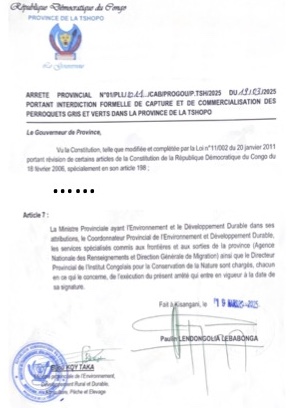
Above, the beginning and end of the 3-page law that, since March 19th, forbids all parrot trade activities in Tshopo Province.
The minister used the International Day of the forest, 21 March, for a first presentation of the decree at Kisangani’s Zoo and Botanical Garden.

The minister’s announcement of the parrot decree was broadcast widely.
We soon realized that we absolutely had to do more. The decree was like a sign: “Construction Permit, Lukuru” without anything on the ground to prove we were building. Where were the bricks, mortar, …who besides us would be the laborers? What if there were confiscations? What would we do with the birds?
John and I returned to Kisangani. Hotels are expensive and this was just the beginning. We rented an empty colonial house to be Lukuru’s northern office and guest house with the three of us, John, Leon and me, as the first guests.

This is how the house looked when we first moved in — Welcome.
We also arranged with the conservation agency (ICCN) to have a space of 50m x 50m at the Zoo. Here, John started to clear brush and put in a first holding cage and a flight cage. We had to be ready.

We located a 50m x 50m space that was remote from the visitors’ path.

John, with a team, measured, cleared brush,

located the area for a flight cage and positioned the structure.

They pulled the flight cage corner’s tight,

And the first flight cage is ready for metal screening.
Kisangani, today’s capital of Tshopo Province, is the grand central for illegal wildlife trade – parrots included. In colonial days, it was the Belgian’s first Interior post – called Stanleyville. Even in the colonial era it was the crossroads where ivory, from wholesale elephant massacres, accumulated to be shipped to Kinshasa (Leopoldville) and out.

In colonial times Stanleyville (Kisangani) was a center for ivory collection and shipment to the Atlantic and up to Europe.
As recently as 2016, Lukuru helped stop a ring of elephant poachers whose ivory moved from forest to Kisangani, then internationally.
Now, caged parrots travel down the currents of the Lualaba, the Aruimi and the Tshopo to be offloaded at Kisangani, the bend in the great Congo River.

Dugouts are often lashed together for transport on the Lualaba – this one moving downstream towards Ubundu and Kisangani.
Parrots are also carried down forest paths to be transported by motorcycle along unmaintained roads. Buyers wait in Kisangani.

Parrots on the back of a motorcycle.

Rainy season on the road in a parrot capture area.
Tshopo funnels the traffic from the northeastern forests including the provinces of Ituri, Bas-Uele, Nord-Ubangi and Mongala. Several large, hidden, parrot collecting centers are in Kisangani. From Kisangani the direction is mainly to Kinshasa and then international — out to South Africa, the Middle East, and the far east. There is work to do!
What made us hesitant to step north, into Tshopo, was the importance of the trade here. We couldn’t come half-way. A decree forbidding parrot trade is the first step, but the machinery is not in place to assure that the law will be enforced. The law must:
- Be known by enforcers and criminals and all along the trade chain (climbers, motorcycle drivers, boatmen, air-company load masters….);
- Be enforced at every chock point or collecting center in Tshopo….and particularly the big ones;
- Result in arrests and confiscated parrots. The latter must receive care until rehabilitated and then released.
So, we knew if we got our feet wet, we would have to swim; if we swam, we would have to flap off the water and fly.
We have started:
The minister asked us to organize a meeting to inform all the law enforcement agencies in Tshopo. Done.

The meeting was held the 28th of March; above the head of information services is next to Madame the Minister Koy.
As the RVA (= Federal Aviation Administration) did not come to the meeting, the minister, herself, has proposed a trip to the airport. This is important, particularly as we discovered that there has been at least one shipment of parrots since the decree was signed.

Parrots about to be loaded at Bangoka airport.
We are settling in for the long haul: in the house we hooked up both the sometimes-electricity and the occasional-water. We bought two mattresses and mosquito nets and four plastic chairs. There were three small tables in the house, but they needed serious work. A compartment in one table had become an active bee hive. No one dared go on the porch. We called in a friend of a friend to move the queen and her workers somewhere else. While she was at it, Louise recovered some great honey from the six significant combs!

Louise preparing smoker.
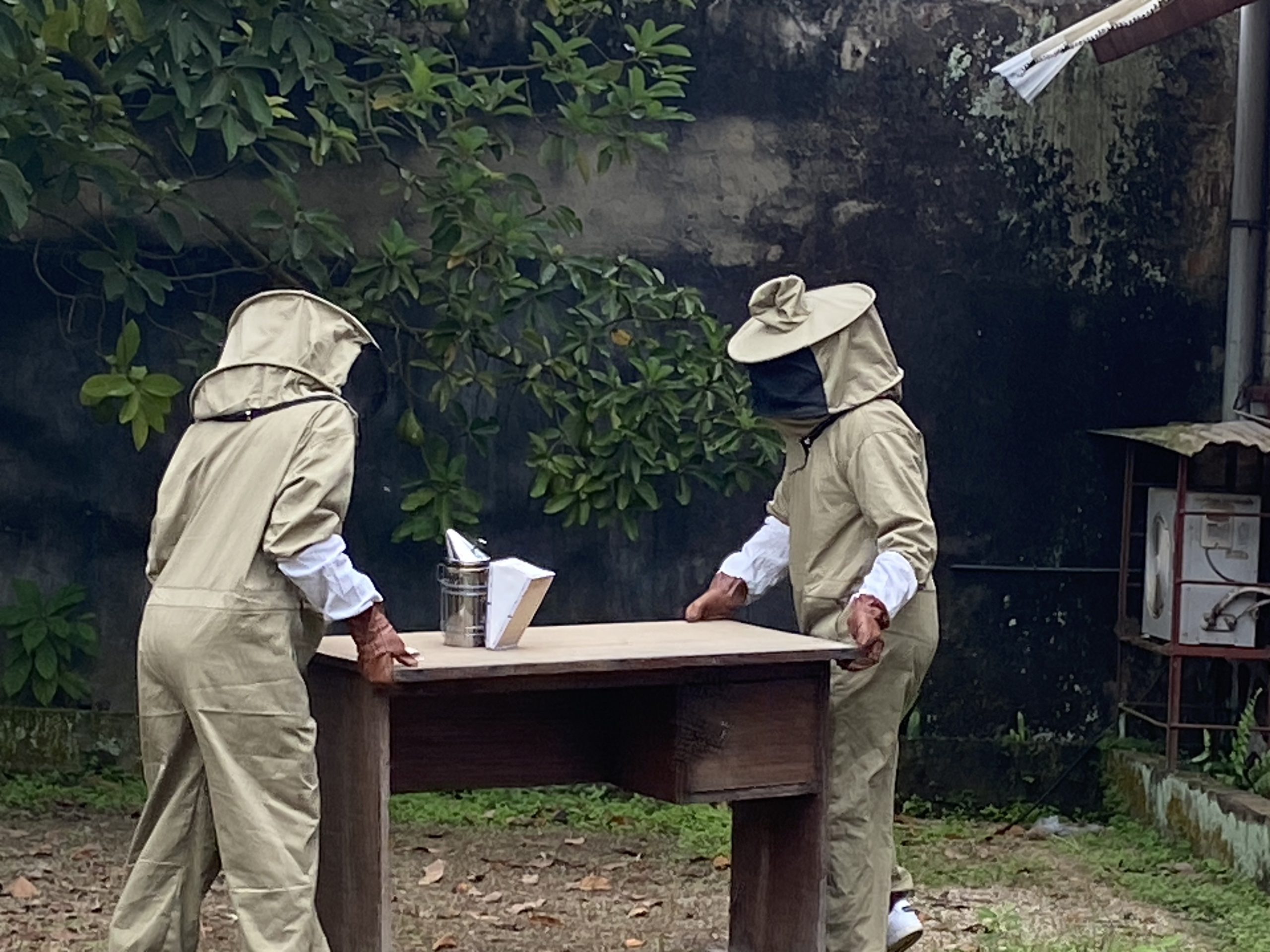
Louise and Robert move the table outside.
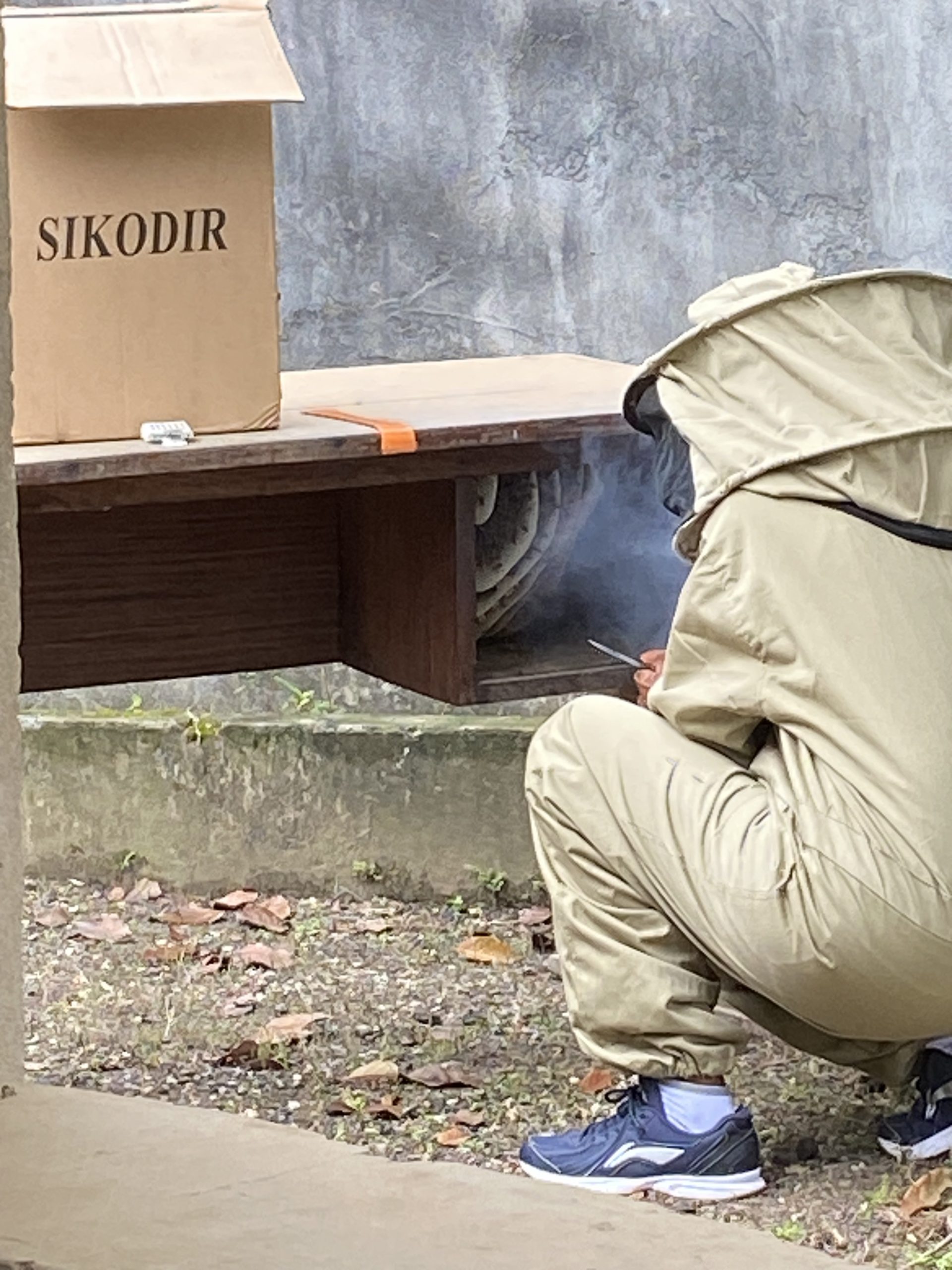
This was an established colony with six combs inside.

Louise examines a comb for the queen.

There was a temporary home, but now queen and workers have a new hive Louise prepared elsewhere.
Good to sweeten the start of the long haul – hopefully we can maintain an upbeat and equally sweet progression. To make success in the north more probable, please contribute. You can do it now, here.

